She’s right, it has been over a year since I have gone into see her. When put that way, it seems like ages, yet not long enough. I’ve been doing what I thought she had asked though, getting my high level screening done twice per year. I had surely hoped that would have covered my bases. Unfortunately, it doesn’t and just isn’t enough.
Yes, I took a break from writing and yes, I guess I took that same break from going in to see the breast care team. Perhaps it was the reality that I am a few short years away from having an extremely invasive surgery. Perhaps it was the fact that I struggle through the “when” discussion every time I see her. Perhaps I can’t get my arms around the magnitude of research that needs to be done to determine which type of surgery makes the most sense for me, and when. Avoidance can only get me so far, I suppose.
The phone call last week took me out of hiding and brought me back to reality. You can imagine my surprise when my doctors called to request I come in for a thorough exam after having just gone through yet another MRI. But why? Hadn’t I done what was needed? A 3D Mammogram and a not so fun MRI every year just isn’t enough? I continue to learn something new along my previvor journey and realize BRCA gals collectively need every ounce of their breast reviewed, scanned, poked and prodded several times per year to remain proactive in their journey. Some cancers, particularly those that start in the nipple, are more easily found through an exam and wouldn’t necessarily be seen through the scans. Don’t get me started on the mixture of frustration this brings me, as I relied too heavily on the conversation-free scans that I’ve come to know.
While I am confident and hopeful that I am in good shape since my recent MRI came back clean, it still adds unnecessary stress to wonder and worry about what else might be cookin’ in there. And, for those with a BRCA mutation, everything is more likely, even if something like Paget’s Disease of the Nipple is very rare in general. Paget disease of the breast/nipple is a rare type of cancer involving the skin of the nipple and, usually, the darker circle of skin around it. As many as 50 percent of people who have Paget disease of the breast have a breast lump that can be felt in a clinical breast exam. The last time the girls and I “chatted,” they were lump free, which the clean scans support. However, having said that, the doctor called out some unique features about my left lady that will require additional ongoing “review” to make sure that everything is in tip top shape to ensure cancer doesn’t start in my nipple. Sorry for the visual, dad.
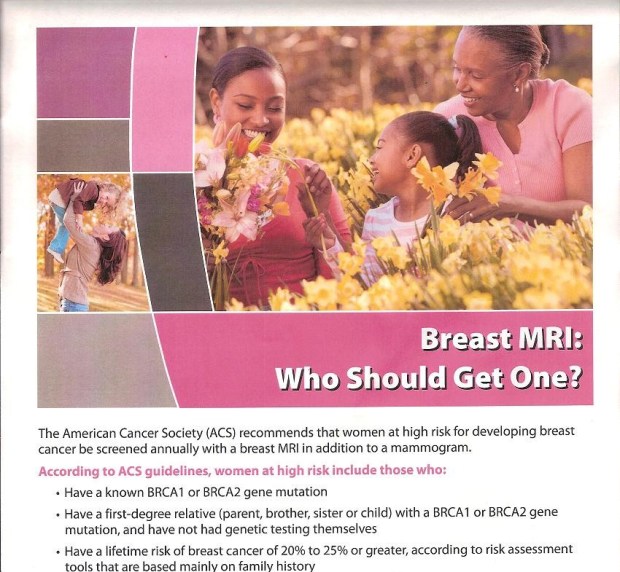
I go back and forth. I am ever so thankful for the knowledge that I have but many days I struggle with it. Time is ticking by too quickly and I would just love to enjoy my kids without the little voice in my head taunting that cancer will find me before I take care of things on my end at the recommended age of 35. I need more time, but there really just isn’t enough time. There are constant reminders everywhere. Sitting in the MRI waiting room two weeks ago, I had a chance to review a set of informational pamphlets. They called out that the top category of women that need a breast MRI were ones that have been diagnosed with a BRCA1 or BRCA2 mutation. The increase in awareness over the past few years has been interesting to watch, as doctors are realizing the role a gene that has almost a 90% trigger rate can have on a young woman’s life. Yet, when I see a brochure like this all I hear is the clock ticking away.
And while some may challenge that continuing with surveillance only is a better option for me, it might be helpful for readers and fellow BRCA gals to know that surveillance can in some cases actually increase my risk for cancer. Women who carry mutations in some genes that increase their risk of breast cancer may be more likely to develop radiation-associated breast cancer than the general population because those genes are involved in the repair of DNA breaks, which can be caused by exposure to radiation according to cancer.gov. If you were in my shoes, what would you do? Would you listen to the medical professionals on your breast care team urging surgery or would you gamble and continue with a high level of surveillance which also may cause cancer anyway?
As much as the reality is frustrating, I need to take a deep breath and rely on Him instead of my own worry. Yesterday my mom made a very good point when she said, “You know, He has a much greater plan for how all of this will go, Carey.” She is absolutely right.

I need to remember this and stay positive, research what I can and do my best to champion this knowledge and support others in their journey as well. I need to think that someday I will be an example of strength and empowerment for my daughter. That someday she will understand the magnitude of decisions her mama has had to make at an early age, starting with my first previvor surgery last year, all the while still praying she will not have inherited this gene from me. I do my best to follow the “breast care plan” by relying on scans and images but will be smarter now and not avoid that in-person doctor visit where they take their analysis one step further. I will be more thankful for them and try not to close down when they ask “when.”
Most importantly, I will try to trust in Him and follow His plan instead of the one I am trying to put together on my own. After all, doing this on my own just isn’t enough.
xoxo
Carey
 You want me to cut off my WHAT?